
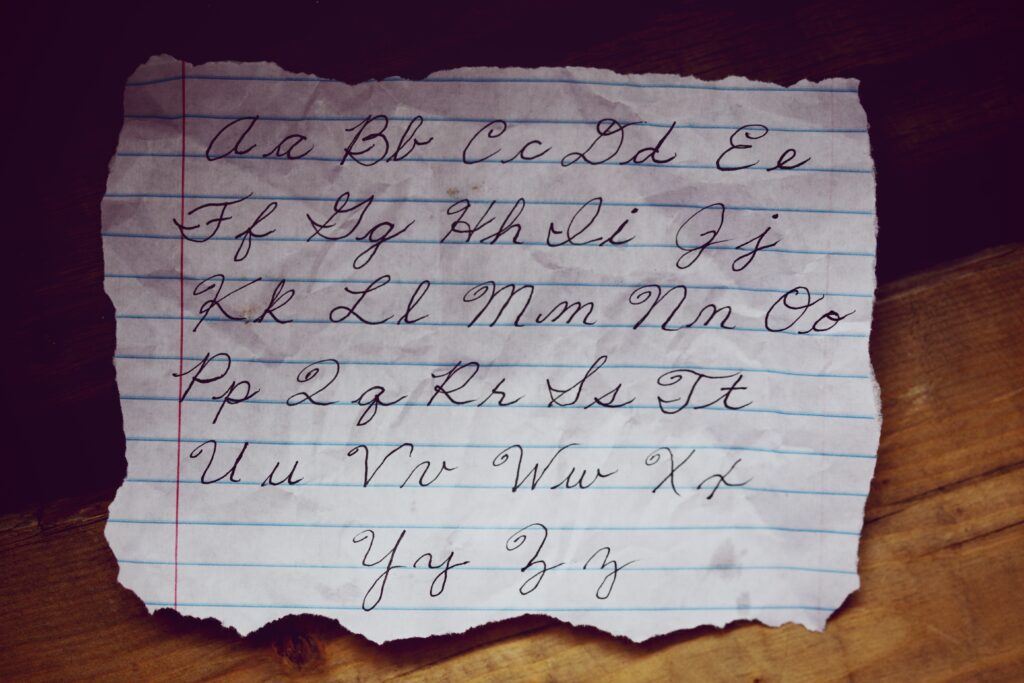
Cursive writing was slowly removed from the classroom more than a decade ago. It returned to the classroom as part of the curriculum in several states. It’s considered an important life skill with cognitive benefits. Schools are encouraged to teach students to write and read in cursive. States show concern over reading and writing scores. Research indicates that handwriting has a positive impact on student learning.
According to Morgan Polikoff, a professor of education at the University of Southern California’s Rossier School of Education, “There is research that suggests that writing things by hand is good for retaining knowledge and is more efficient.” However, legible writing, either print or cursive, is best.
A Link to the Past
After cursive handwriting was eliminated from schools, students were exposed to writing in college. Students in archival research methods, historiography seminars, and specialized topic classes analyzed original letters, diaries, maps, and legal documents written in cursive. They had to learn to read cursive writing.
The growth of technology and the Common Core Standards led to the elimination of cursive writing. Educators felt students needed to learn keyboarding. Laptops and tablets eliminated the use of paper and pencil. Thus, the ability to read and write cursive faded from the classrooms.
Cursive Writing and Cognitive Development
Research indicates that cursive writing has cognitive benefits. Cursive enhances brain development that is related to language, memory, and fine motor skills. The intricate hand and finger movements activate a different part of the brain than typing or printing. Thus, there is an improvement in neural connections for cognitive growth.
Forming printed letters tends to be more difficult for young learners. There are too many stops in the formation, whereas curve writing flows with smooth starts and stops. Also, it helps students with retention and comprehension of written text. Students become more fluent in reading and writing as a result of learning cursive. Students do not have to concentrate on forming the individual letters of print.
Cursive Writing and Dyslexia
Cursive is one tool that helps students with dyslexia. Letters have distinct starting and ending points that eliminate confusion with letter reversals. Handwriting words helps students feel the word, which supports long-term memory. Some dyslexic students find cursive is a faster way to write, thus making the letters clearer.